Trial Xtreme Freedom
- 4.0
- Rating
- 1.00M
- Installs
- Free
- Price

 Analysis by App-foxy
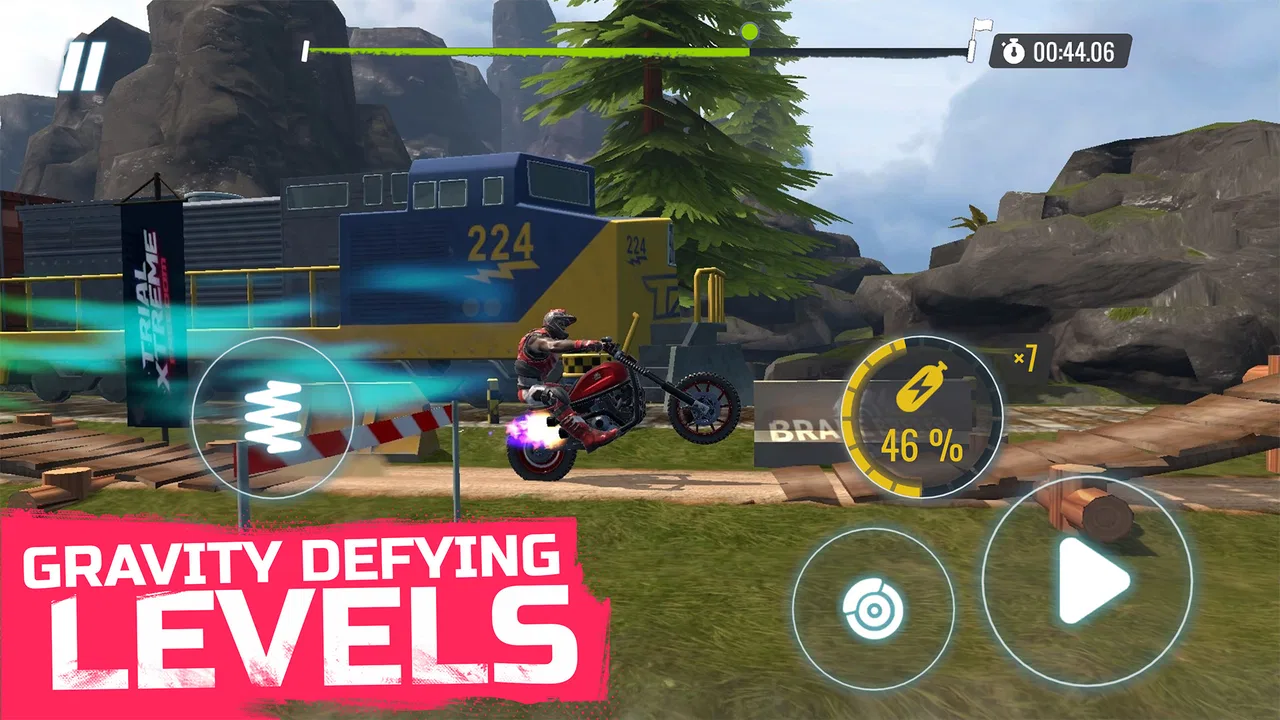
Trial Xtreme Freedom is the kind of racing game I open when I want a quick burst of concentration rather than a long, story-heavy session. Its focus is motorcycle trial racing: control the bike through demanding terrain, keep your balance, and turn jumps and stunts into a clean finish. After spending time with it, I found the appeal easy to understand. The game asks for patience, but it also gives me that satisfying feeling of improving one small movement at a time.
It comes from Gameplay Galaxy and is available as a free game for Android users. The current release is version 1.00.0, and it has already passed one million installs. Those figures suggest that it has found a sizeable audience, but the more useful question is whether its particular style suits you. If you enjoy short races built around timing, control, and spectacular mistakes, it has a clear identity. If you prefer realistic motorsport, deep vehicle tuning, or relaxed arcade driving, I would look elsewhere.
How the current version feels to play
The first thing I noticed is that this is not a conventional racing game where simply holding the accelerator and choosing the best line is enough. The bike’s attitude in the air matters. A jump that looks successful can still end badly if the front wheel lands too early, while a careful adjustment can rescue a run that initially seems lost. That makes each course feel more like a sequence of small decisions than one continuous sprint.
You May Also Like

 Blood Strike: 2.5 Anniversary
Blood Strike’s Loadouts Turn Every Drop Into a Tactical Gamble
A close look at Blood Strike’s custom loadouts: how fast access to signature weapons reshapes its battle royale rhythm, rewards preparation, and narrows the gap between fights.

 Pandora - Music & Podcasts
Pandora’s Music Is Easy to Start, but Harder to Recover
Pandora’s strength is its low-effort path from a seed to a station. Its weak spot is how much confidence it asks you to place in connection, setup, and quiet recovery.

 8 Ball Pool
 Is Built on Rivalries, Rematches, and Routine
A close look at the rivalries, rematches, shared routines, and unanswered safety questions that turn a quick pool match into a persistent mobile community.

 Samsung Music
’s Quiet Strength Is Playing What You Already Own
Its reach comes less from spectacle than from dependable access to a personal library. That simplicity is both the app’s strongest retention engine and its ceiling.

 AccuWeather: Weather Radar
AccuWeather Review: A Quick, Clear Forecast for Everyday Decisions
For everyday plans, the best forecast is the one you can understand quickly. AccuWeather makes rain timing, radar, and local conditions easy to act on, with a few trade-offs.

 Hill Climb Racing
Why Hill Climb Racing Still Turns Crashes Into One More Run
A tiny car, a bumpy hill and one more upgrade: Hill Climb Racing keeps resurfacing because its simple chaos makes every near-miss feel personal.
More From Our News Desk
View All News


I also like how naturally the game fits into short sessions. A failed attempt usually teaches me something immediately: I approached a ramp too quickly, leaned at the wrong moment, or treated a landing as if it were automatic. This makes restarting feel worthwhile instead of frustrating for its own sake. The loop is simple, but the challenge comes from learning the rhythm of each obstacle.
The store presents the game as a high-speed player-versus-player racing experience with extreme stunts and serious competition. In practice, I would describe its strongest appeal as competitive trial riding rather than ordinary track racing. The excitement comes from combining speed with control. A reckless approach may look impressive for a second, but a stable landing is usually more valuable than a flashy mistake.
That distinction is important for new players. I initially wanted to treat every ramp as an invitation to perform the biggest possible stunt. The better approach was to read the obstacle first. Sometimes the fastest-looking move is not the most reliable one, and a modest jump with a clean landing can outperform a dramatic attempt that leaves the bike upside down.
Controls reward small corrections
The control style is best understood as a balance exercise. I found that broad, panicked movements usually create more problems than they solve. Short corrections before takeoff and during flight are more dependable, especially when the bike has enough momentum to carry itself over an obstacle. This is one of the game’s less obvious lessons: success often comes from doing less, not more.
For that reason, I recommend beginning with a deliberately cautious mindset. Use early attempts to learn how much input the bike needs, rather than chasing a perfect result immediately. Once the basic timing becomes familiar, the same courses feel less random. The game still demands precision, but the challenge becomes readable.
Touch controls can be comfortable for players who enjoy direct input, although your experience will depend on the size of your screen and how you hold the device. I prefer playing with both hands and keeping my thumbs relaxed, because tense fingers make quick corrections less consistent. A few minutes spent finding a comfortable grip can make a noticeable difference during repeated attempts.
Why the stunt focus works
Stunts are not just decoration here. They give the racing a visual identity and make every jump feel like a test of confidence. When I land a difficult sequence cleanly, the satisfaction comes from knowing that the result depended on timing rather than luck alone. Even a short run can contain several moments where I have to choose between preserving control and risking a faster, more dramatic move.
The trade-off is that players who want a pure speed contest may find the trial format slower than expected. The game’s best moments are built around obstacle management. You are not simply comparing top speed; you are comparing how well you handle terrain, airtime, landings, and recovery. That makes it more technical than a basic pick-up-and-play racer.
What the free model means in practice
The game is free to download, which makes it easy to try without committing money at the start. It includes in-app purchases ranging from ninety-nine cents to ninety-nine dollars and ninety-nine cents per item. I would advise treating those purchases as optional convenience or progression spending rather than assuming they are necessary for the core experience.
My practical advice is to play long enough to decide whether the riding itself is enjoyable before buying anything. In a game built around skill, spending should not replace learning the controls. If you are the kind of player who enjoys mastering difficult sections, keeping your progress focused on practice may be more satisfying than paying to move ahead quickly.
Parents should also note that the content rating is Everyone, which makes the game broadly accessible from an age-rating perspective. That does not remove the need to supervise purchases on a shared device. I would enable the usual purchase protections if a child will be playing, especially because the available item range reaches well beyond the cost of a small one-time game.
What has changed and what existing players should expect
The current version is 1.00.0, and the game was released on July 25, 2026. That places it at an early point in its product life, so I see this release as a starting platform rather than proof of a fully mature racing ecosystem. The important distinction is between what I can judge now and what may develop later. The present experience already has a recognizable motorcycle-trial identity, but long-term depth will depend on how Gameplay Galaxy continues to support it.
For a new player, the early version has one advantage: the central idea is easy to understand. You can quickly tell whether balancing a bike through jumps is fun for you. For an existing player, the same simplicity may feel more significant. Early adopters are likely to care about whether future releases add meaningful variety, improve competitive balance, and keep the challenge fresh rather than merely adding more reasons to replay the same type of obstacle.
I would not judge the game by expecting it to behave like a long-established racing franchise. Its current identity is narrower and more focused. That can be a strength when you want a clean, skill-based session, but it also creates pressure for future development. A trial racer needs enough variety in terrain and goals to prevent every run from blending into the next.
The public response is encouraging but still relatively small compared with the install count: the game holds a 4.0 average from 454 ratings and has 22 written reviews. I read that as a reasonable sign of interest, not as a final verdict. A rating at that level suggests the experience works well for many players while leaving room for different opinions about controls, progression, or the free-to-play structure.
How the release affects different kinds of players
If you are new to motorcycle trial games, this release gives you a straightforward way to discover the genre. You do not need to understand racing lines in the traditional sense. Instead, you learn how speed, balance, and landing position interact. That makes it approachable at the concept level, even though later challenges can demand careful practice.
If you already play similar stunt racers, the main question is whether this particular handling style feels distinct enough to keep your attention. I would download it when I want compact attempts and visible mechanical improvement. I would not replace a deeper racing game with it if my priority were detailed vehicle setup, broad track selection, or a substantial single-player campaign.
There is also a useful everyday scenario for it. Imagine having ten minutes before an appointment or during a commute break. A single attempt can give you a clear objective, and a failed run does not require a large emotional investment. You can stop after one success or continue trying to clean up a troublesome jump. That makes it more practical than games that require a long uninterrupted session before anything meaningful happens.
On the other hand, I would skip it during moments when I want something calming. The repeated restarts and precision demands can become tense, particularly when a run fails near the end. It is relaxing only if you enjoy concentration and gradual mastery. For a low-effort way to pass time, a gentler arcade racer is likely a better match.
Small techniques that improve consistency
My first useful technique was to separate speed problems from balance problems. When a jump fails, I ask whether the bike lacked momentum or whether the landing angle was wrong. Adding speed to a balance mistake usually makes the next attempt worse. This simple diagnosis prevents random changes and helps turn failure into a specific adjustment.
A second technique is to prepare before the obstacle rather than reacting at the last possible instant. The bike’s position at takeoff strongly influences what can be corrected in the air. I get better results when I enter a ramp already aligned, instead of trying to repair a poor approach after leaving the ground.
A third is to value a clean finish over an impressive middle section. Stunts are tempting because they make a run feel successful, but the final landing is what confirms that the sequence worked. When I am learning a course, I use conservative landings first and only add risk after I can complete the route reliably.
Finally, I recommend changing your session goal. Instead of always chasing the fastest result, try completing one difficult section without a crash, then try improving the next section. This creates smaller targets and makes progress easier to notice. It is especially useful when the game begins to feel repetitive, because you are testing a specific skill rather than replaying without a plan.
Where it still feels limited
The biggest limitation is the narrowness of the core loop. Motorcycle control, jumps, stunts, and competition are a strong foundation, but they must be supported by enough variety to maintain interest. If you need a game with many different racing disciplines, elaborate customization, or a strong narrative, this is not the right choice.
The free-to-play structure may also affect how different players perceive progress. Some people are comfortable enjoying the available riding and ignoring purchases. Others may feel pressure if optional items appear too closely tied to advancement or competition. Because the listed item prices range from a small impulse purchase to a much larger payment, I would set a personal spending limit before playing rather than deciding in the heat of a frustrating attempt.
Another point is the difference between spectacle and control. The game’s stunts look like its headline attraction, but the lasting appeal depends on whether the handling feels fair. When a failure clearly follows from my input, I want to retry immediately. When I cannot tell why the bike behaved a certain way, the same challenge feels less rewarding. New players should give themselves time to learn the physics before deciding whether a difficult section is genuinely unfair.
Device compatibility is also worth checking before installing. The game requires Android 7.0 or later, so older phones may not be eligible. On a supported device, I would still close unnecessary apps before a serious session, particularly if smooth touch response matters to you. In a precision racer, even minor distractions can make a control problem feel like a gameplay problem.
How it compares with familiar racing alternatives
Compared with a conventional circuit racer, Trial Xtreme Freedom puts much more emphasis on vertical movement and bike control. Traditional racers are usually about braking points, corner exits, and choosing a racing line. Here, the critical moment may be a landing angle or the amount of balance maintained over an obstacle. Choose this game when you want physical puzzle-solving wrapped in racing; choose a circuit racer when overtaking and lap strategy are your main interests.
Compared with an open-world driving game, it is more focused and less exploratory. You are not downloading it to wander through a large environment or build a long-term driving lifestyle. Its value is in the immediate challenge of a run. That focus is helpful when you have limited time, but it may feel restrictive if discovery and freedom are what keep you playing.
Compared with a casual endless runner, it demands more deliberate input. You cannot always rely on reflexes alone, because successful movement depends on anticipating what comes next. The reward is greater control and a stronger sense of mastery, but the cost is a steeper learning curve. I would recommend it to someone who enjoys retrying a section with a slightly different approach, not to someone who wants automatic forward momentum.
Who should install it now
I recommend the game to players who enjoy stunt motorcycles, short competitive attempts, and skill-based repetition. It is particularly suitable if you like seeing improvement through cleaner landings rather than unlocking a large collection of unrelated activities. The free entry point also makes it sensible for anyone curious about trial racing but unwilling to buy a full game before understanding the format.
I would be more cautious if you dislike restarting, have limited patience for learning physics, or expect a large amount of content immediately. Players who want deep simulation, realistic motorsport rules, or extensive tuning should choose a more specialized racing title. The same is true for anyone who wants a completely purchase-free experience with no temptation to spend.
For me, the strongest reason to keep it installed is the compact feedback loop. I can identify a mistake, change one part of my approach, and test the result almost immediately. That is a better use of the game than mindlessly chasing every stunt. The weakest reason would be expecting it to provide endless variety without continued development.
What I will watch as the game evolves
Because the release is still at version 1.00.0, I would watch for updates that deepen the riding rather than simply expanding the surface. New types of obstacles, more meaningful competitive goals, and improvements that make difficult failures easier to understand would all strengthen the foundation already present.
I would also pay attention to how the purchase system fits into competition. Optional spending feels less intrusive when skill remains the main factor and when players can understand what they are buying. Clear progression and fair challenges matter especially in a game that presents itself around competition.
Another important sign will be whether returning players have reasons to revisit familiar courses. Fresh targets, varied stunt demands, or better ways to compare performance could extend the life of the current mechanics. Without that kind of evolution, the early excitement may fade once players have learned the main patterns.
My overall view is positive but measured. Trial Xtreme Freedom is at its best when you treat every jump as a control problem, not just a chance to show off. Gameplay Galaxy has a clear racing concept here, and the free download makes trying it easy. I would recommend it to anyone who enjoys motorcycle trials and does not mind repeating a section until the timing clicks. I would skip it if your ideal racer is about broad exploration, realistic simulation, or effortless speed. As an early release, it is worth watching: the core is promising, while its long-term success will depend on how much meaningful variety grows around it.
In short, I would install Trial Xtreme Freedom for focused sessions, careful stunt practice, and the satisfaction of turning unstable landings into reliable finishes. Start without spending, learn the bike’s rhythm, and decide based on how much you enjoy the act of improving. That approach gives the game a fair chance while keeping its limitations and purchase options in perspective.
FAQs for Trial Xtreme Freedom
01What is Trial Xtreme Freedom?
Trial Xtreme Freedom is a motorcycle trial game focused on challenging obstacle courses, precise riding, and stunt-style gameplay. Players control a dirt bike through ramps, platforms, jumps, and uneven terrain while trying to reach the finish line without crashing. Progress generally depends on learning each track, improving control, and completing increasingly demanding challenges.
02Is Trial Xtreme Freedom free to download and play?
The game can generally be downloaded for free on supported mobile devices, but availability and pricing may vary depending on the Android or iOS store and your region. Like many mobile racing games, it may include optional in-app purchases, such as upgrades, customization items, or other progression-related content. Check the store listing before downloading to review current purchase information.
03Does Trial Xtreme Freedom require an internet connection?
Some parts of Trial Xtreme Freedom may work without a constant internet connection, particularly basic single-player track gameplay. However, online features, advertisements, cloud-related functions, events, updates, or purchases may require internet access. For the most reliable experience, connect to Wi-Fi or mobile data when launching the game, especially after installing an update or accessing online content.
04Is Trial Xtreme Freedom suitable for beginners?
Trial Xtreme Freedom can be enjoyed by beginners, although its physics-based controls may take time to master. Keeping the motorcycle balanced, controlling acceleration, and landing jumps correctly are more important than simply moving quickly. New players should expect a learning curve, especially on later tracks, but repeated attempts and careful throttle control make the game progressively easier.
05What devices are needed to play Trial Xtreme Freedom smoothly?
The exact requirements depend on the version available in your region and whether you are using Android or iOS. In general, the game should run best on a reasonably modern device with updated system software, sufficient free storage, and enough memory for 3D gameplay. Older phones or tablets may experience slower performance, longer loading times, or reduced visual quality.
Pros
- Fast-paced bike physics make short sessions exciting.
- Multiple bikes and upgrades add variety to progression.
- Simple controls are easy to learn on a touchscreen.
- Stunt-focused tracks reward experimentation and risky moves.
- Offline play is useful when you have no internet connection.
Cons
- Some levels rely heavily on precise timing and repeated attempts.
- Progression can feel slow without spending time on upgrades.
- Ads may interrupt the experience between races or attempts.
- Physics occasionally send the bike into awkward
- unpredictable landings.
- Limited track variety may reduce long-term replay value.

Trial Xtreme Freedom
Gallery